Methanol production from C1 compounds
Biocatalytic conversion of methane to methanol
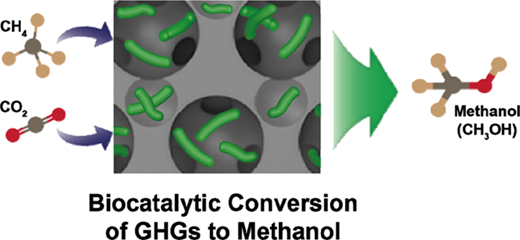
Methanotrophs oxidize methane to methanol through methane monooxygenase, which offers higher selectivity under mild conditions than thermochemical routes. Whole-cell immobilization improves methane oxidation performance and allows cell reuse. Earlier work encapsulated methanotrophs in polymer matrices containing copper, iron, or magnetic nanoparticles and used simulated biogas and wheat-straw-derived biogas as feedstocks. Cells were also immobilized on chemically modified chitosan, banana leaves, and hierarchical macroporous particles, and methanotroph co-cultures were designed to raise methanol production. These studies examine how carrier chemistry and cell composition affect methanol formation from greenhouse gases.
Related publications
- Hierarchical Macroporous Particles for Efficient Whole-Cell Immobilization: Application in Bioconversion of Greenhouse Gases to Methanol. ACS Applied Materials & Interfaces 2019. doi:10.1021/acsami.9b03420
- Conversion of biogas to methanol by methanotrophs immobilized on chemically modified chitosan. Bioresource Technology 2020. doi:10.1016/j.biortech.2020.123791
- Biomethanol Production from Methane by Immobilized Co-cultures of Methanotrophs. Indian Journal of Microbiology 2020. doi:10.1007/s12088-020-00883-6
- Integrating anaerobic digestion of potato peels to methanol production by methanotrophs immobilized on banana leaves. Bioresource Technology 2021. doi:10.1016/j.biortech.2020.124550
- Synthetic design of methanotroph co-cultures and their immobilization within polymers containing magnetic nanoparticles to enhance methanol production from wheat straw-based biogas. Bioresource Technology 2022. doi:10.1016/j.biortech.2022.128032
- Encapsulation of Methanotrophs within a Polymeric Matrix Containing Copper- and Iron-Based Nanoparticles to Enhance Methanol Production from a Simulated Biogas. Polymers 2023. doi:10.3390/polym15183667
- Polyhydroxyalkanoate Production by Methanotrophs: Recent Updates and Perspectives. Polymers 2024. doi:10.3390/polym16182570